
Introduction
Chain stitch (ch) is the most fundamental and important stitch in crochet. It is the starting point for all crochet projects - whether it's a simple scarf or a complex sweater, nearly every crochet piece begins with chain stitches. Chain stitches are not only used for starting foundations, but also for connecting, turning, and decorative edges during the crocheting process.
Chain stitch is called Chain Stitch in English, abbreviated as ch. In crochet diagrams, chain stitches are usually represented by small oval circles. Mastering chain stitch is the foundation for learning other stitches, because almost all subsequent stitches involve working into chain stitches or yarn over operations.
Chain stitches are characterized by being simple to learn and highly flexible. By adjusting the number and tension of chain stitches, you can create chains of different lengths and tightness. For beginners, practicing chain stitches helps familiarize with the feel of crochet hook operation, laying a solid foundation for learning more complex stitches.
The structure of chain stitches is also important: the front shows a V-shape (two small braids), and the back has a raised line called the back loop. When working subsequent rows, you can choose different methods such as working into the back loop, front loop only, or both loops plus back loop, each method producing different effects.
Tools Needed
Before starting chain stitch practice, you need to prepare the following tools:
- Crochet hook: Beginners are recommended to use a 3.0mm or 3.5mm hook, which is a moderate size for easy control
- Yarn: Choose medium-weight cotton or wool yarn in a bright color for easy stitch visibility
- Scissors: For cutting the yarn
Tool Selection Tips
Beginners are advised to use thick yarn with a larger hook (4.0mm or above), this way the stitches are clearer and easier to understand each step of the operation.
Step-by-Step Instructions
1Step 1
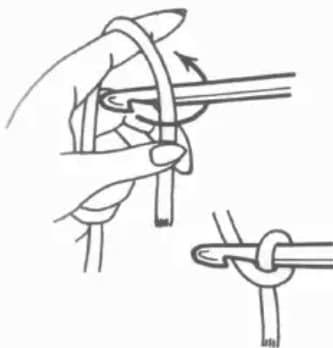
Place the hook outside the working yarn, pick up the yarn as shown by the arrow, rotate the hook head so that the yarn forms a cross on the hook.
2Step 2
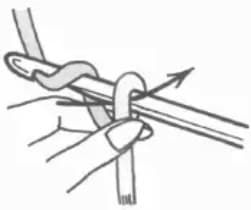
Use your index finger and thumb to hold the yarn at the cross point, then yarn over the hook, pull the yarn through as shown by the arrow, forming the first slip knot.
3Step 3
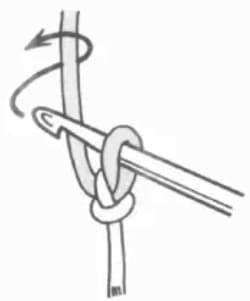
Yarn over the hook as shown by the arrow, preparing to work the first chain stitch.
4Step 4
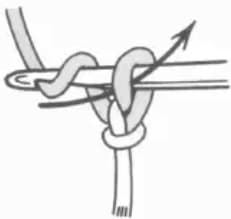
Pull the yarn through as shown by the arrow. The first chain stitch is complete, now there is one loop on the hook.
5Step 5
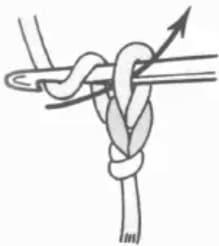
Following the technique from steps 3 and 4, yarn over the hook and pull through as shown by the arrow. The second chain stitch is complete.
6Step 6
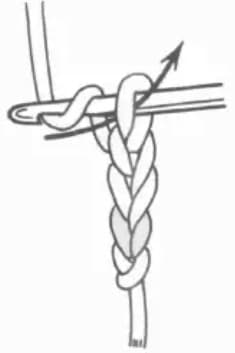
Repeat steps 3 and 4, continue crocheting. After completing the 4th chain stitch as shown, you can see the chain gradually forming.
7Step 7
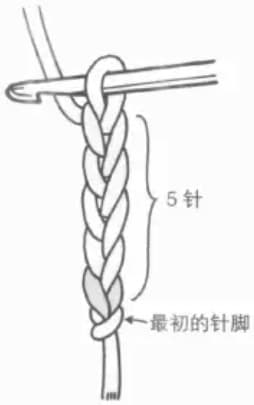
After crocheting 5 chain stitches as shown. Note: The initial slip knot and the loop on the hook do not count as stitches, actual counting starts from the first complete chain stitch.
Tips
Maintain Even Tension
The tension of chain stitches affects how subsequent stitches are worked. During practice, try to maintain consistent tension for each pull-through so all chain stitches are the same size. Too tight chain stitches make subsequent work difficult, while too loose chain stitches affect the overall appearance of the piece.
Counting Method
When counting chain stitches, remember: the starting slip knot does not count as a stitch, and the loop on the hook does not count as a stitch either. Count from the first complete chain stitch. For example, if a pattern calls for "5 chains", you need to first complete the starting slip knot, then crochet 5 complete chain stitches (that is, 5 yarn over and pull-through operations).
Use a Counter
For projects that require many chain stitches (such as scarf foundations), you can use a counter or mark every 10 stitches to avoid counting mistakes.
Common Mistakes
What if my chain stitches are too tight?
This is the most common problem for beginners. Chain stitches that are too tight make it difficult to insert the hook for subsequent stitches, and the finished piece will be stiff. Solution: Relax your wrist tension, slightly loosen each pull-through; you can also try practicing with a larger hook to establish the correct tension feel, then switch back to the appropriate hook.
What if I keep miscounting chain stitches?
Miscounting usually happens because the counting starting point is not correctly understood. Remember: the starting slip knot and the loop on the hook are not counted. It's recommended to re-count from beginning to end after finishing. You can also use safety pins or small clips to mark specific stitch positions for easy reference.
What if my chain stitches are uneven in size?
Uneven chain stitches affect the appearance of the finished piece. The cause is usually inconsistent tension or unstable hand position. Solution: Slow down during practice, focus on controlling tension for each pull-through; maintain a stable wrist position and use the same hand motion for each stitch.
Related Stitches
After mastering chain stitch, you can continue learning these basic stitches:
- : The most basic crochet stitch, the foundation for working into chain stitches
- : Used for joining and finishing, often used together with chain stitches
- : Another common starting method, suitable for round projects
Practice Suggestions
Beginners are recommended to practice crocheting 20-30 chain stitches daily until each stitch can be completed evenly and smoothly. During practice, try different thicknesses of yarn and hooks to build familiarity with different materials. Once chain stitches are mastered, you can start learning other stitches and gradually complete simple projects.
Chain stitch is the first step in crochet - master it and you've opened the door to the world of crochet. Keep practicing and enjoy the fun of crocheting!